
September 26, 2026
11 min read
Ombré Brows in Geneva: Powder, Microshading or Microblading?
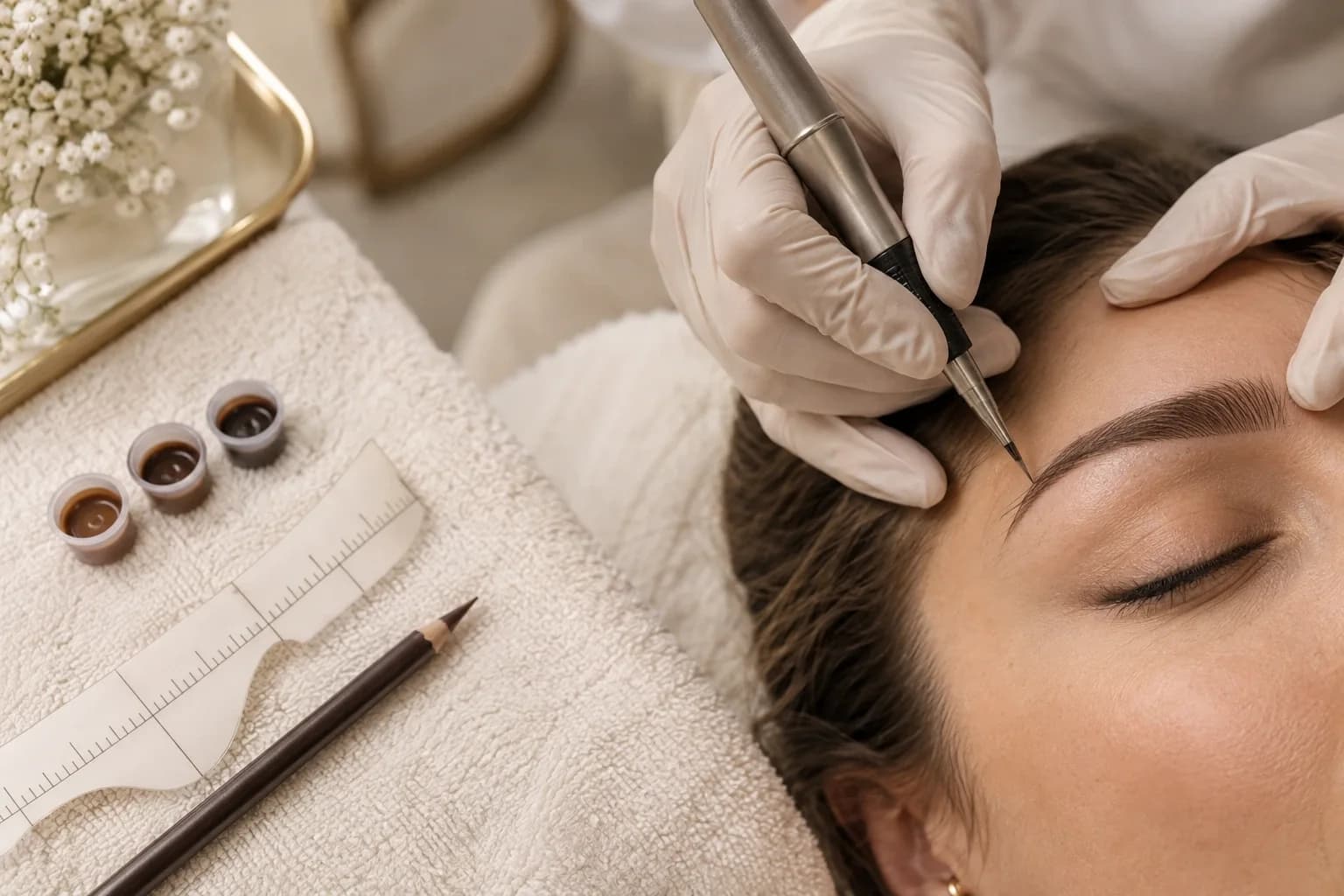
Choosing semi-permanent brows is exciting, but the vocabulary can be confusing. Ombré brows, powder brows, microshading, microblading, combo brows: five names, several overlapping techniques, and a lot of contradictory advice online. If you are looking for ombré brows in Geneva or simply want to understand which option suits your face and your skin, this guide walks you through the real differences, what each technique asks of you in terms of healing and maintenance, and how the decision is usually made at the consultation.
One honest note before we start: no article can replace an in-person skin assessment. Your technician will confirm what is realistic for your skin, your natural brows and your lifestyle.
The five techniques in plain words
All five are forms of cosmetic tattooing: pigment is placed in the upper layers of the skin and fades gradually over months. What changes is the tool, the pattern the pigment makes, and therefore the finished look.
Ombré brows and powder brows
Ombré brows, also called powder brows or powdered brows, use a small machine to place extremely fine dots of pigment into the skin. The result is a soft, shaded effect that resembles a brow filled in with powder or pencil. The "ombré" part describes the gradient: lighter at the front of the brow, gradually deeper towards the tail. You can read how the treatment works step by step on our ombré brows page.
In everyday conversation, "powder brows" and "ombré brows" are used almost interchangeably. When people make a distinction, "powder" sometimes refers to a more even, makeup-like fill, while "ombré" always implies that light-to-dark fade. At the salon, both are booked as Ombré Brows and the intensity is adjusted to you.
Microshading
Microshading also creates a shaded rather than stroked brow, but with a lighter, more diffused touch: a series of tiny dots or fine lines build a softly tinted effect. It is often described as the most subtle of the shading options. At Beauty Art Pro it is offered as Microshading / Blade & Shade, following the Beauty Angels Academy method. More detail on our microshading page.
Microblading
Microblading is a manual technique. A handheld tool with very fine needles draws individual hair-like strokes that imitate your natural hairs. It is the most "invisible" option on the right skin, because it reproduces hair texture rather than colour. See our microblading page for the full procedure.
Combo brows
Combo brows (also called hybrid brows, or Blade & Shade) combine both worlds: hair strokes at the front of the brow, where natural hairs are sparse and fine, then soft shading through the body and tail for depth and definition. Details are on our combo brows page.
Which look do you actually want?
Before thinking about skin type, start with the result you picture when you imagine waking up with finished brows. Most people fall into one of these profiles:
- "I want to look like I'm not wearing anything." You like your natural brows, you just want them fuller or more even. Microblading or light microshading are usually the starting points.
- "I fill my brows in every morning with powder or pencil." You like a polished, defined result. Ombré brows reproduce that routine permanently and are often the most satisfying choice here.
- "I have gaps at the front and want definition at the tail." Combo brows were designed precisely for this situation.
- "I have very little brow hair left." Shading techniques, alone or combined with strokes, tend to give a more convincing and longer-lasting base than strokes alone, because there are few natural hairs to blend with.
Intensity is adjustable within each technique. An ombré brow can be kept airy and soft, and a microshaded brow can be built up to be more defined. What the technique changes is the texture of the result: strokes, powder, or both.
Choosing by skin type: oily, dry, mature, sensitive
Skin type is the factor clients most often underestimate, and it has a real impact on how pigment heals. The points below reflect what is generally observed in permanent makeup; your own skin may behave differently.
Oily skin and enlarged pores
On oily skin, the fine strokes of microblading tend to soften, blur and fade faster, because the skin renews itself actively and sebum can spread pigment during healing. Hair strokes may heal less crisp than on dry skin. Shading techniques such as ombré or powder brows are generally the more predictable choice here, since a soft blurred edge is part of the intended look. If you have oily skin and still prefer hair strokes, the salon offers a dedicated microblading touch-up for oily skin at 3 to 4 months, which tells you how much more maintenance it can require.
Dry and normal skin
Dry to normal skin usually holds all techniques well. It is the skin type on which microblading strokes stay the finest and sharpest. Your choice can therefore be driven mainly by the look you want.
Mature skin
With age, skin often becomes thinner and less elastic. Very fine incisions are not always the kindest option, and strokes can heal less crisply. Soft shading, through microshading or a gentle ombré, is frequently recommended because it adds structure and colour without asking too much of the skin, and it can also compensate for thinning hairs.
Sensitive or reactive skin
If your skin reacts easily, tell your technician at the consultation, along with any known allergies or conditions. Treatments are not carried out on irritated, sunburnt or inflamed skin in the brow area, and it can take a visit to confirm the right timing. The salon works with REACH-compliant pigments (brands such as Beauty Angels Academy, Brow Daddy, Permablend and Biotek), but no pigment can promise zero reaction for every person.
Comparison table: look, longevity, maintenance, price
The table below brings together the figures from the salon's own service and booking pages. Longevity always depends on your skin, sun exposure, skincare and aftercare.
| Technique | Finished look | Often suited to | Typical longevity | New application at Beauty Art Pro |
|---|---|---|---|---|
| Ombré / powder brows | Soft powder gradient, light front to defined tail | Oily, combination, mature skin; people who wear brow makeup | 1 to 2 years | 430 CHF, about 2h30 |
| Microshading / Blade & Shade | Very soft, diffused tint | Mature, fine or sensitive skin; natural look | 12 to 24 months | 400 CHF, about 2h30 |
| Microblading | Individual hair-like strokes | Dry to normal skin, some natural hairs present | Up to 18 months | 300 CHF, about 2h |
| Combo brows | Strokes at the front, shading through the tail | Sparse fronts, need for depth, most skin types | 12 to 18 months | 450 CHF, about 2h30 |
Touch-ups are priced separately. For ombré brows, the 4 to 6 week touch-up is 200 CHF and the annual touch-up (12 to 18 months) is 300 CHF. A consultation only appointment is 40 CHF for 30 minutes, and when you book a new ombré application, the consultation is included. The complete list is on our service prices page.
Your Sanctuary Awaits
Ready to Experience the Art?
“Secure your appointment today and join our community of elegant women in Geneva.”
What healing really looks like
Every technique goes through a similar healing process, and knowing it in advance avoids a lot of worry. For ombré brows, healing takes roughly 2 to 4 weeks. The brows look darker at first, then lighten as the skin heals. Here is what most people experience, although timelines vary:
| Period | What you may notice | What to do |
|---|---|---|
| Days 1 to 3 | Colour looks bold and sharp; slight redness or swelling that usually settles in a day or two | Follow the cleaning and aftercare routine you are given; don't touch unnecessarily |
| Days 4 to 10 | Light flaking and itching as the surface renews | Never pick or scratch; let flakes fall off on their own |
| Days 10 to 21 | Colour can look patchy or too light ("ghosting") | Be patient: pigment is still settling under the new skin |
| Weeks 4 to 6 | Colour and shape stabilise and reveal the healed result | Attend your touch-up to perfect colour and fill any gaps |
During the first week in particular, avoid swimming and prolonged water exposure, saunas, heavy sweating, sun on the brows and active skincare (acids, retinol, exfoliants) around the treated area. Your technician will give you detailed aftercare adapted to your technique.
Microshading and microblading heal in a similar way, with some redness and dryness for a few days. Microshading is often perceived as more comfortable during the procedure than microblading, although everyone's sensitivity is different. A topical numbing cream is applied for all these treatments; most people describe the feeling as mild discomfort, close to tweezing.
Touch-ups and long-term maintenance
A single session is rarely the finished result. Skin does not accept pigment evenly everywhere, and the healed colour is always softer than on day one. That is why the complete treatment includes:
- A first touch-up at 4 to 6 weeks, to correct any patchy areas, adjust the colour and refine the shape once the skin has fully healed.
- Maintenance touch-ups as the colour fades: every 12 to 18 months for ombré and combo brows, 6 to 15 months for microshading / Blade & Shade, 6 to 12 months for microblading on normal skin, and 3 to 4 months for microblading on oily skin.
In the long run, the difference between techniques is less about how much a single session costs and more about the rhythm of maintenance. Microblading has the lowest entry price but can require more frequent visits, especially on oily skin. Ombré brows cost more upfront but generally need less frequent maintenance.
To keep your brows beautiful between visits: use daily sunscreen around (not on fresh) brows, avoid applying exfoliating acids or retinol directly on them, and let your technician know about any changes in your skin or medication.
Who should wait or avoid permanent makeup
Permanent makeup is not right for everyone at every moment. The situations below usually require postponing treatment or seeking medical advice first; the list is not exhaustive, and your consultation will go through your personal health history.
- Pregnancy or breastfeeding
- Active skin conditions in the brow area (eczema, psoriasis, acne, dermatitis, infection, cold sores near the face)
- A tendency to keloid or hypertrophic scars
- Recent or current treatments that affect skin or healing, such as isotretinoin, blood thinners, chemotherapy, or recent injectables near the brows
- Uncontrolled diabetes, clotting disorders or immune conditions, where medical advice is needed first
- Known allergy to pigments or topical anaesthetics
If you have existing old brow tattoos, bring this up as well: it changes what can be done and sometimes means lightening first.
How to choose at your consultation
The consultation is where the technique is really decided. Expect your technician to:
- Look at your skin: oiliness, pore size, thickness, sensitivity and any previous work.
- Listen to your routine and your taste: do you wear brow makeup every day, do you prefer a barely-there result or a polished finish?
- Map and draw the shape using your facial proportions, so you can approve it before any pigment is placed.
- Choose the pigment shade according to your hair colour and skin undertone.
- Recommend a technique, explaining why, and set honest expectations for healing and touch-ups.
Don't be surprised if the recommendation differs from what you had in mind. A technician who suggests shading instead of strokes on oily skin is protecting your result, not upselling you. You can also read what other clients say on our reviews page.
ART
Ombré and combo brow prices
Conclusion: the right brows are the ones that suit your skin
Ombré, powder, microshading, microblading and combo brows are not competing trends; they are tools for different skin types and different ideas of beauty. Hair strokes shine on dry to normal skin and for a natural look; shaded brows heal more predictably on oily or mature skin and suit anyone who loves a defined finish; combo brows bridge the two.
The simplest way to know is to come and talk. At Beauty Art Pro, Rue Neuve-du-Molard 19 in the heart of Geneva, your consultation will assess your skin, draw your shape with you and recommend the technique that makes sense, with no promise the skin cannot keep.
Your Sanctuary Awaits
Ready to Experience the Art?
“Secure your appointment today and join our community of elegant women in Geneva.”