
September 26, 2026
10 min read
Kobido Massage in Geneva: A Guide to the Japanese Natural Facelift
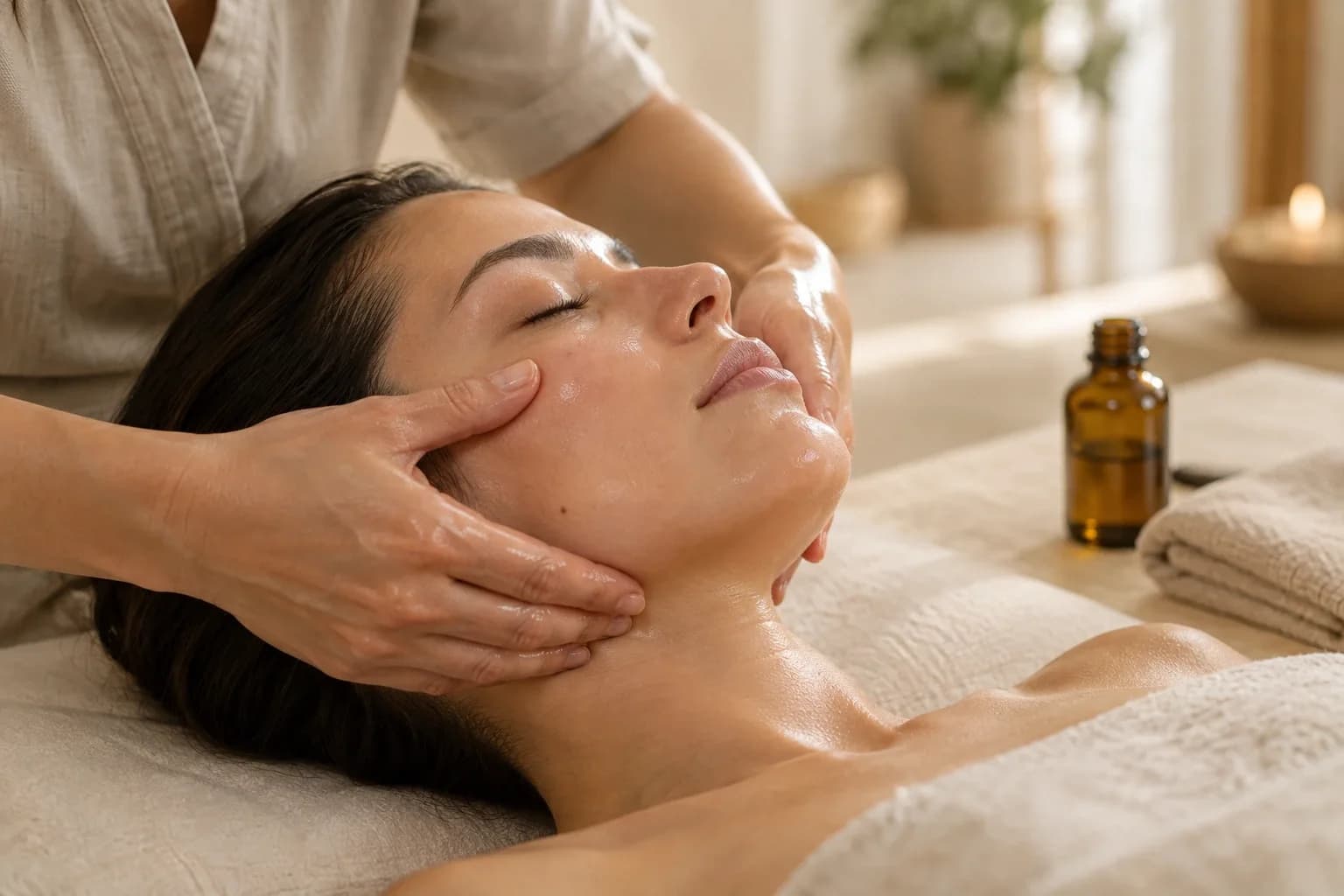
Some facials rely on machines. Others rely on hands. Kobido firmly belongs to the second group. This traditional Japanese facial massage, whose name is often translated as "the ancient way of beauty", has become one of the most talked-about treatments of recent years, frequently described as a "natural facelift". But what can you realistically expect from it? What happens during a session, how often should you book, and how does it differ from a regular facial?
This guide answers those questions honestly, so you can decide whether a Kobido massage in Geneva suits your skin, your schedule and your goals.
Where Kobido comes from: a Japanese art passed from master to student
Tradition traces Kobido back to fifteenth-century Japan. The story goes that two masters of anma, the traditional Japanese massage, combined their knowledge to create a sequence of movements devoted entirely to the face. For a long time the ritual is said to have been reserved for the imperial court and the nobility, before being handed down through generations of practitioners.
As with many ancient practices, history and legend are hard to separate precisely. What is clear is that Kobido reflects a Japanese view of beauty in which appearance and well-being are inseparable: a relaxed, well-nourished face is considered a more radiant face.
The name is usually broken down like this:
- Ko: ancient, traditional;
- Bi: beauty;
- Do: the way, the path.
That origin explains the spirit of the treatment: a slow, precise, rhythmic ritual in which the quality of each gesture matters more than any device.
Kobido techniques: pressure, smoothing and percussion
What sets Kobido apart from a simple relaxing face massage is the variety and speed of its movements. The practitioner follows a precise choreography across the face, neck and décolleté, alternating very fast sequences with slow, deeper work.
The core movements
- Rhythmic pressure: along the facial muscles and specific points, to release tight areas such as the jaw, forehead and around the eyes.
- Smoothing strokes: long gliding movements that work the tissues and follow the contour of the face upwards.
- Percussion and tapping: quick movements with the fingertips or the edge of the hand that stimulate microcirculation.
- Light pinching and kneading: to work on tone, particularly over the cheeks and along the jawline.
- Drainage movements: gentle strokes directed towards the lymph nodes to support lymphatic flow and reduce a puffy look.
Why the oil matters
For these gestures to glide without dragging the skin, the treatment relies on oil. At Beauty Art Pro the ritual uses organic jojoba oil, which is close to the skin's own sebum and offers excellent glide without a greasy film, followed by Utsukusy serums (Dragon's Blood or hyaluronic acid) at the end. You will find the full protocol on our Kobido massage in Geneva page.
The "natural facelift" effect: what to really expect
"Natural facelift" is everywhere, and the phrase deserves an honest explanation. Kobido is not a surgical facelift and does not replace one. It does not permanently tighten the skin, and it does not change the structure of your face.
What it can offer, however, is very real for many people:
- A more relaxed face: by releasing contracted muscles (a clenched jaw, a furrowed brow), features often look more rested.
- A brighter complexion: stimulating microcirculation usually brings a visible glow straight after the session.
- Less puffiness: drainage movements can temporarily reduce under-eye bags and that swollen morning feeling.
- A more defined contour: together, these effects often give the impression of a firmer, more "lifted" face.
Results vary from person to person depending on age, skin quality, lifestyle and how regularly you come. They are largely temporary, and it is repetition that maintains them. We would rather say that clearly than promise guaranteed results.
A Kobido session in Geneva, step by step
At Beauty Art Pro, on Rue Neuve-du-Molard in the heart of Geneva, the ritual follows five main stages.
| Stage | What happens | Purpose |
|---|---|---|
| 1. Preparation | Meticulous cleansing | Prepare the skin for the oil and active ingredients |
| 2. Muscle stimulation | Deep pressure and smoothing | Release tension and work on elasticity |
| 3. Targeted sculpting | Focused work on the eyes, jawline and forehead | Redefine the key areas of the face |
| 4. Lymphatic drainage | Rhythmic tapping and drainage strokes | Reduce puffiness and bags |
| 5. Active protection | Application of Utsukusy serums | Nourish the skin and prolong the effect |
The options on the menu
Depending on your time and your goal, there are several formats (prices as listed on the salon's booking page):
ART
Kobido prices
Prices can change, so always check the service prices page or the booking page for up-to-date rates.
Before and after your appointment
Ideally, arrive without heavy make-up, or simply plan for it to be removed at the start. Mention anything relevant about your skin or health before the treatment begins. Afterwards, your skin may look slightly flushed for a short while, a sign of stimulated circulation. Drink water, avoid layering lots of products that day and, if you can, keep the evening calm to make the relaxation last.
Your Sanctuary Awaits
Ready to Experience the Art?
“Secure your appointment today and join our community of elegant women in Geneva.”
The benefits of Kobido: skin, tension and sleep
For your skin
By stimulating microcirculation, Kobido massage supports a fresher, more even complexion. Drainage movements help de-puff the face, while the jojoba oil and serums add nourishment and comfort, particularly for dry or tired skin.
For tension
This is often the benefit people feel first. Many of us clench our jaw, frown at screens or hold stress in the forehead and temples. Kobido works on exactly these areas. If you suffer from teeth grinding or jaw joint pain, the massage may feel soothing, but it is not a substitute for medical or dental advice.
For sleep and well-being
The rhythm of the treatment, alternating fast and slow movements, invites a state of deep relaxation. Many clients describe feeling calm and falling asleep more easily that evening. This is a relaxation effect, not a treatment for sleep disorders; if your nights are persistently disturbed, speak to your doctor.
Contraindications to know about
Kobido suits most skin types, but it is not recommended in certain situations:
- severe acne or inflamed breakouts;
- active rosacea;
- significant skin conditions (eczema, psoriasis, infection);
- notable circulatory problems (varicose veins, a history of thrombosis);
- pregnancy: check with your doctor before booking.
Please also mention any recent injections (hyaluronic acid fillers, botulinum toxin), facial surgery or ongoing dermatological treatment. If in doubt, a consultation beforehand will confirm whether the treatment is right for you.
How often should you have Kobido?
Consistency makes all the difference. For the best results, the salon generally recommends a session every 2 to 4 weeks, but the right rhythm depends on your goal. Here are some indicative guidelines, which your consultation will fine-tune:
| Your goal | Typical frequency | Format that often suits |
|---|---|---|
| Discovering the treatment, a moment of calm | A one-off session | Kobido Complet or Express |
| Keeping a radiant complexion | Every 3 to 4 weeks | Kobido Complet |
| Working on tone and facial contour | Closer sessions at first, then every 2 to 4 weeks | Kobido Complet or Signature |
| A glow before an event | A few days beforehand | Kobido Express or Complet |
| Maintenance after a course | Roughly every 4 weeks | Kobido Complet |
Packages are available so you can enjoy several sessions at a more favourable rate; just ask when you book.
Kobido vs other facials: which one to choose?
Kobido is not "better" than another facial; it answers a different need. The table below sums up the main differences.
| Criterion | Kobido | Classic facial | Chemical peel |
|---|---|---|---|
| Principle | Intensive manual massage | Cleansing, mask, hydration | Exfoliation with active acids |
| Main target | Muscles, tension, circulation | Skin surface | Texture, pigmentation, radiance |
| How it feels | Deeply relaxing, rhythmic | Gentle, cocooning | Sometimes a tingling sensation |
| Downtime | Usually none | None | Depends on strength |
| Ideal for | Tired, tense face, softer contour | Regular skin maintenance | Skin texture, blemishes |
In short: if your priority is relaxation and a firmer-looking face, Kobido is an excellent choice. If you mainly want to address texture or blemishes, a targeted facial or peel may be more relevant. Very often, the two complement each other.
Combining Kobido with other treatments
Kobido pairs well with other facials (hydrating, anti-ageing or targeted) for a more complete result. A few common-sense principles:
- With a facial: Kobido can come before or after a hydrating treatment, depending on the protocol your therapist chooses.
- With a peel: it is generally best not to massage freshly exfoliated skin. The order and gap between the two will be set at your consultation.
- With lash and brow treatments: a lash lift can complement a rested-looking face, but massaging around the eyes straight after a lash treatment is usually avoided, so plan your appointments accordingly.
- After injections: wait for your doctor's go-ahead before any firm facial massage.
The simplest approach is to mention it when you book, and the team will suggest a sequence that suits your skin and your diary. You can also read our client reviews to get a feel for the experience at the salon.
Why choose Beauty Art Pro for Kobido in Geneva
In the heart of Geneva, a short walk from the main shopping streets, Beauty Art Pro has made Kobido one of its signature treatments. The ritual combines traditional technique with carefully chosen products: organic jojoba oil and Utsukusy serums. Every session is adapted to the person on the table: Kobido is not painful, and pressure is always adjusted to your comfort.
You can choose a 30-minute express break, a full one-hour treatment or the 90-minute Signature ritual, which leaves time to go further into relaxation. Kobido can also be given as a gift card, a thoughtful present for someone close to you.
Your Sanctuary Awaits
Ready to Experience the Art?
“Secure your appointment today and join our community of elegant women in Geneva.”
Conclusion: give your face the gift of time
Kobido is neither a magic wand nor a substitute for surgery. It is a demanding, time-honoured Japanese craft that helps the face relax, regain radiance and look more toned, especially when practised regularly. It is also, quite simply, an hour just for you.
If you are unsure about the format, the frequency or whether it suits your skin, the best step is to talk to us. Book your first Kobido in Geneva through our booking page, and we will review your expectations together and recommend the ritual that fits you best.